Category Articles
McTeigue: Lent is here – and we need it more than ever
Lent? Again? Really?
Catholics of various stripes — including the fallen away, the alienated, the angry, the indifferent and the earnest —may be wondering why the Church is still marking the season of Lent at this late date in our secular culture.
Read this essay at The Boston Herald.
Preaching in a Time of Misdirecting Shepherds

Let’s start with the Gospel of Matthew, 10:26-32. There we can learn something about the general judgment. We’re all mindful (or should be) of our own particular judgment, but there is the general judgment where all will be revealed for the greater glory of God. It must be revealed for all not only that God is merciful, but that God is just and that God’s judgments are right and true.
Read this essay at Crisis Magazine.
Yes, Some Moral Acts Are Disordered—Here’s Why

“END WOMEN’S SUFFRAGE!”
According to legend, these words were emblazoned upon a sign at a booth taking signatures for a petition at a Lilith Fair, a popular summer concert series featuring female musicians. A comedian had set up the scam in order to demonstrate the alarming ignorance of the American electorate. The story goes that he collected hundreds of signatures, and no one was the wiser.
Read this essay at Catholic World Report.
Thoughtful Repartee About the Times — and How Christians Can Best Respond
Do we need Christendom?
First of all, what is it?
Jesuit Father Robert McTeigue offers two answers, a positive and a negative one.
A Brief History of Our Annihilation

I don’t like where we are headed. We’re running out of goods to reject or destroy. We’re almost at the point of no return.
Read this essay at Crisis Magazine.
Remembering 2020 Without Losing Hope
Do you remember January 2020? A U.S. airstrike on January 3 killed top Iranian Gen. Qassem Soleimani and others near Baghdad International Airport. Two weeks later, the House impeachment managers read aloud the impeachment articles against then President Trump…
One person who saw this coming was Fr. Robert McTeigue, S.J., a philosophy and theology lecturer, host of the radio program The Catholic Current, and author of the new book, Christendom Lost and Found: Meditations for a Post Post-Christian Era.
Read the essay at Crisis Magazine.
Christians at the End of the Pax Americana
“The king is dead! Long live the king!” These words have been used in both history and literature as a powerful means of reassurance. The populace is reassured that even in the face of crisis represented by the death of a king, there is an orderly transition of power: one king follows another, without interruption. (Whether the populace should find such an announcement reassuring is another question.) In neither history nor literature can I find this declaration: “The empire is dead! Long live the empire!” Why this lack, this lacuna, even though empires rise and fall and are succeeded by other empires in their turn? This question is on my mind as I watch in real time what I believe is the accelerating decline and impending demise of the American empire.
Read this essay at New Oxford Review.
Even Catholic Social Transformation Must Be Rooted in Prayer
In a very interesting series of “meditations for a post post-Christian era”, Jesuit Fr. Robert McTeigue shares what is essentially a journal of his thoughts during the COVID era of 2020-2021, under the arresting title of Christendom Lost and Found. In his own reflective and anecdotal way, Fr. McTeigue emphasizes the perception that if we are not seeking to shape a society that is Christian in every possible respect, we aren’t really living a fully Christian life.
Read the essay at Catholic Culture.
Revitalizing Christian faith and culture in a post post-Christian era
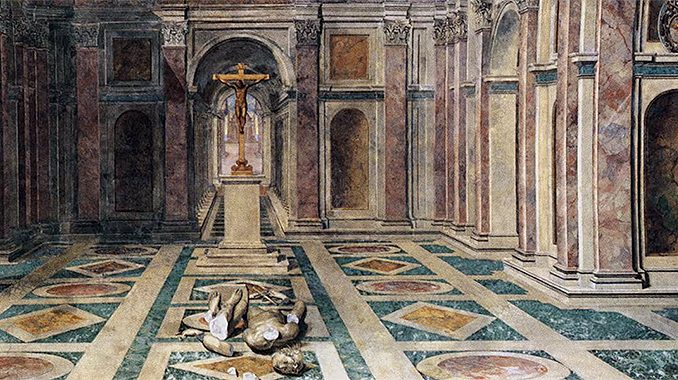
It was 2020, in the depth of COVID lockdowns, when one priest began writing. The unthinkable was taking place: Easter in the United States would be “canceled”. Churches would be shuttered. It was in this environment that Christendom Lost and Found: Meditations for a Post Post-Christian Era was written — a series of meditations about the state of the Church and Christendom, along with thoughts about where we ought to go from here.
Read the article at the Catholic World Report.
The Guns of August—Then and Now

It seems to me that the similarities between August 1914 and August 2022 are all disturbing: venal and clumsy politicians, states clashing as they rise and fall, an overconfidence in human wisdom and an underestimation of human vulnerability.
Read this essay at Crisis Magazine.